Blobs.perimeter_approx#
- Blobs.perimeter_approx(**kwargs: Any) Any[source]#
Approximate perimeter of blob
- Parameters:
epsilon (int) – maximum distance between the original curve and its approximation, default is exact contour
- Returns:
Perimeter, one point per column
- Return type:
ndarray(2,N) or list of ndarray(2,N)
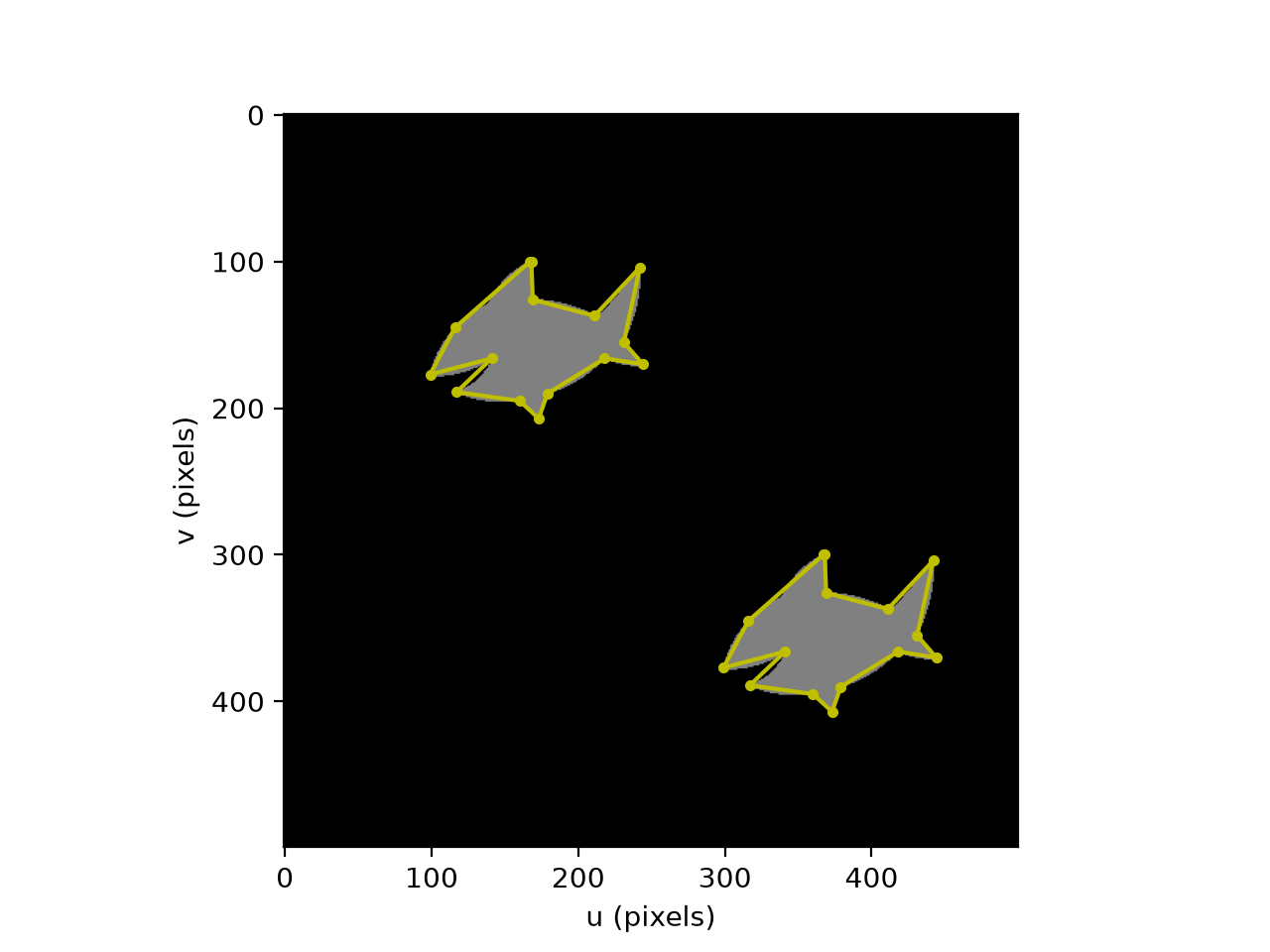
The result is a low-order polygonal approximation to the original perimeter. Increasing
epsilonreduces the number of perimeter points.Example:
>>> from machinevisiontoolbox import Image
>>> im = Image.Read('shark2.png')
>>> blobs = im.blobs()
>>> blobs[0].perimeter.shape
(2, 471)
>>> blobs[0].perimeter_approx(5).shape
(2, 15)
>>> np.set_printoptions(threshold=10)
>>> blobs[0].perimeter_approx(5)
array([[367, 316, 299, ..., 411, 369, 368],
       [300, 345, 377, ..., 337, 326, 300]], shape=(2, 15), dtype=int32)
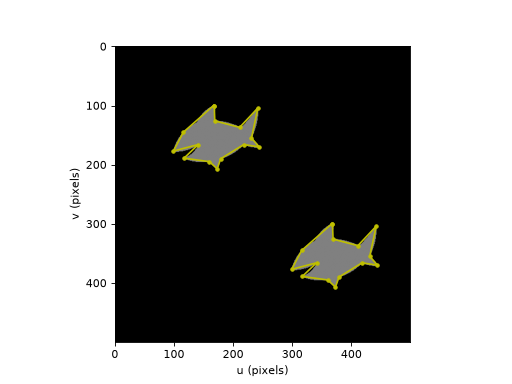
which in this case has reduced the number of perimeter points from 471 to 15.
To compute parameters of the area enclosed by the approximated perimeter we can first convert it to a
Polygon2object:>>> from spatialmath import Polygon2 >>> poly = Polygon2(blobs[0].perimeter_approx(5), close=True) >>> poly.area() np.float64(7169.0) >>> poly.moment(1, 0) # first moment np.float64(-2657962.3333333335)
(
Source code,png,hires.png,pdf)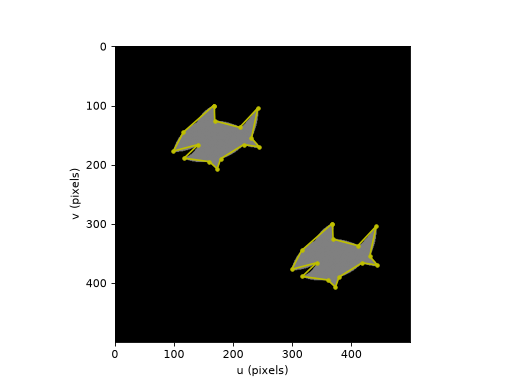
Note
The perimeter is not closed, that is, the first and last point are not the same.